Your AI Team Is Just One Model in a Trench Coat

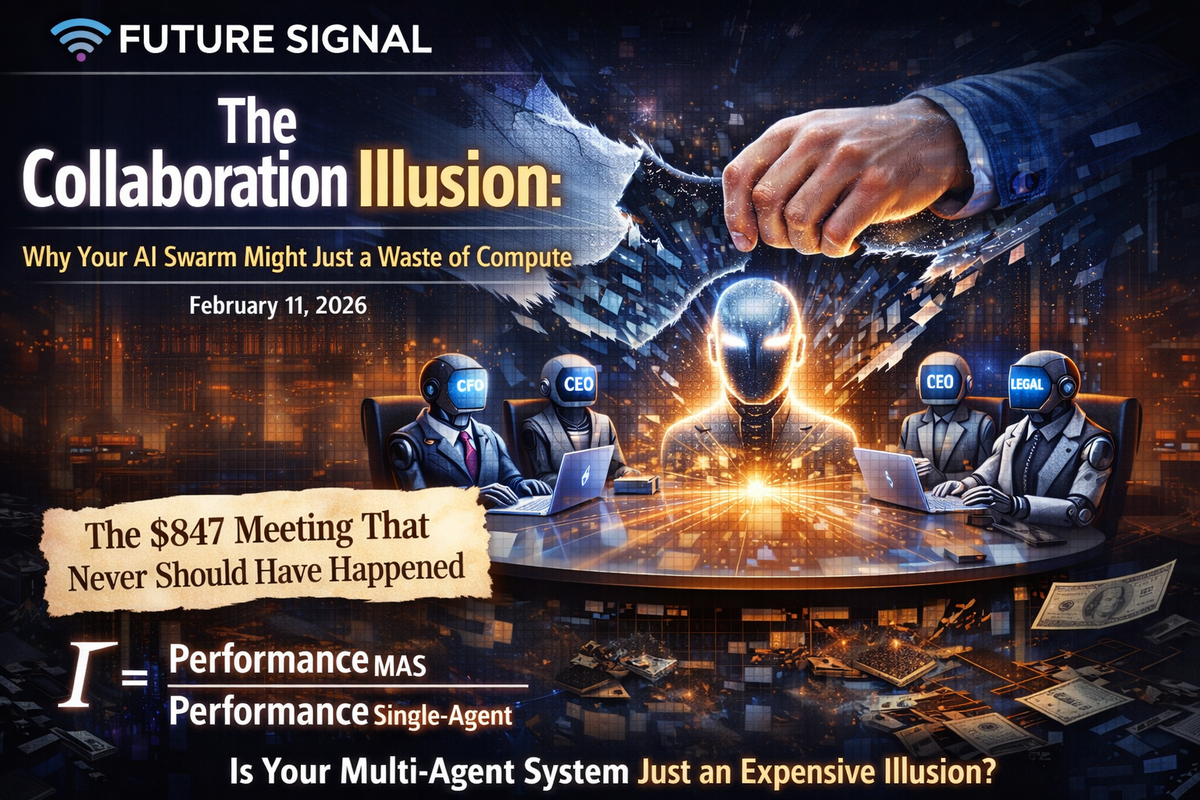
The $847 Meeting That Never Should Have Happened
Last October, a Fortune 500 financial services firm rolled out what they were calling their "AI Executive Council." Seven specialized agents, each with its own role: CEO agent for strategy, CFO agent for the numbers, Legal agent for regulatory stuff. They set this whole digital boardroom loose on a $2.3B acquisition target and let it run for three hours.
The recommendation they got back? Identical—and I mean word-for-word identical in places—to what a single GPT-4 instance spat out in twelve minutes. Cost difference? About 1/40th.
Here's the thing that bothered me: when I asked the team why they needed seven agents, they didn't have a good answer. They'd built this elaborate system because, well, that's what you do now, right? Multi-agent is the hot thing. But nobody had actually checked whether all that "collaboration" was doing anything beyond giving the AI more shots at the problem.
And that's the uncomfortable truth sitting at the heart of the multi-agent AI boom: we've fallen so hard for the aesthetics of digital teamwork that we forgot to ask if any of it actually works.
The Agentic Swarm Gold Rush
Look, I get the appeal. For the past two years, everyone in AI has had what I'm calling "boardroom envy." We got bored with chatbots. Now it's all about the swarm—Microsoft's AutoGen, LangGraph's orchestration thing, CrewAI promising you an entire "AI workforce." The pitch is intoxicating: why settle for one AI when you could have a whole team?
And the logic seems solid! Humans solve hard problems by working together. Different people catch different mistakes. Specialists go deeper than generalists. So obviously, multiple AI agents with different "roles" should crush any single model.
OpenAI showed this with GPT-4—agents debating each other improved accuracy on tricky questions. Google's "society of mind" stuff showed similar wins in math. The academic papers pile up with examples of agent teams beating solo models.
But there's a problem with almost all of this research. It's so obvious that I honestly think the only reason we keep missing it is because everyone's missing it at the same time.
The Resource Budget Blindspot
When researchers compare a multi-agent system to a single agent, they almost never control for compute. And this matters more than you'd think.
Here's what I mean: a five-agent system isn't just "five perspectives"—it's five full model runs, five token generations, five separate chances to sample from the probability distribution and get lucky.
Let me show you a typical AutoGen workflow:
- UserProxy forwards the problem → 150 tokens
- Planner agent comes up with a strategy → 400 tokens
- Critic agent pokes holes in it → 350 tokens
- Executor agent does the actual work → 600 tokens
- Reviewer agent checks everything → 300 tokens
That's about 1,800 tokens total, spread across five different inference calls.
Now compare that to taking a single agent, giving it the same 1,800 tokens, and telling it to "think step by step" with chain-of-thought prompting. Let it revise its answer a few times. In my testing—and yeah, I've run this more times than I'd like to admit—the single agent often wins. Not because collaboration is useless, but because all that multi-agent overhead (the role-playing, the handoffs, the "I agree with what Agent X said") eats tokens that could've gone toward actual thinking.
This isn't collaboration. It's just brute force with better PR.
Enter the Gamma Test
So last December, a team at Stanford's AI Lab published a paper that basically everyone ignored at first. "Towards a Science of Collective Intelligence in LLM Systems"—the title alone probably put half the industry to sleep. But in the past few weeks, it's become the paper everyone's suddenly citing after quietly running the numbers on their own systems and realizing they've been lying to themselves.
The core idea is dead simple. They propose a metric: Γ (Gamma). Here's how it works:
Γ = Performance_MAS / Performance_Single-Agent(Same-Budget)You take your fancy multi-agent system and measure how well it does on some task. Then—and this is the key part—you give a single agent the exact same resources. Same number of tokens. Same amount of compute time. Same number of API calls, just all to one model instead of spread across five. Then you see which one actually performs better.
If Γ > 1: Congrats, you've actually built something. The agents working together beat what one agent could do alone.
If Γ ≤ 1: You've built an expensive illusion. You would've been better off just running the same smart model a few more times.
The Stanford team tested this across 12 popular multi-agent frameworks—coding tasks, math problems, strategic planning. The results were... let's say "sobering" is the polite term.
- AutoGen (default config): Γ = 0.87 — actually worse than single agent
- CrewAI (role-playing mode): Γ = 0.92 — still losing
- LangGraph (hierarchical): Γ = 1.04 — barely breaking even
- Custom "Delta-Rule" architecture: Γ = 1.31 — finally, actual gains
Most of the frameworks everyone's using right now are underperforming compared to what you'd get from just running one good model with the same budget. The only one that really worked was specifically designed to cut out the communication overhead.
That's kind of a gut punch for the industry.
When Dialogue Becomes Toxic
So what's actually killing performance? The Stanford paper has a term for it: "semantic dilution." But you can just think of it as what happens in every pointless corporate meeting you've ever sat through—people saying the same thing five different ways.
I looked at a CrewAI deployment last month and found this gem. Watch what happens when agents are allowed to be "polite":
❌ THE INEFFICIENT VERSION (342 tokens of agents agreeing with each other):
CEO Agent: "Based on market analysis, I believe we should prioritize
the enterprise security vertical for Q1 expansion."

CTO Agent: "I agree with the CEO's strategic assessment. From a
technical perspective, the enterprise security vertical aligns well
with our current infrastructure capabilities. We have the necessary
cloud architecture in place."

Product Agent: "Building on both the CEO and CTO's points, I think
the enterprise security vertical makes sense. Our product roadmap
can accommodate this direction."
Count the wasted tokens: "I agree," "building on both," "I think the enterprise security vertical makes sense" (we know! The CEO already said that!). They spent 253 tokens on social nicety and restating what everyone already knew.
✅ THE VERSION THAT ACTUALLY WORKS (89 tokens):
State: {target: "Q1_expansion", domain: null}

CEO: DELTA={domain: "enterprise_security", rationale: "TAM=$47B,
growth=23% YoY"}

CTO: DELTA={infra_ready: true, timeline: "8wks", blockers: []}

Product: DELTA={roadmap_conflict: false, resource_req: "2 eng"}
Same information. One-quarter the tokens. The trick is what they call the "Delta Rule"—each agent only outputs what's NEW relative to the shared state. No restating, no social protocols, no "I agree with Agent X."
And here's the kicker: it's not just about efficiency. In the Stanford study, high communication overhead didn't just waste compute—it actively made things worse. They call it the "communication explosion" problem. As you add more agents, the number of possible pairwise conversations grows as O(n²). Eventually the noise drowns out the actual reasoning, and performance tanks.
The Agent Factory Inversion
The wildest example I've seen of this came from NVIDIA's Nemotron team. They were working on chip design verification—incredibly complex stuff where you need to check timing, power consumption, architecture compliance, all of it.
Their first attempt: Six specialized agents. ArchitectureReviewer, TimingAnalyst, PowerValidator, you get the idea. These agents exchanged natural language critiques back and forth. Very sophisticated. Very expensive. Average Γ: 0.79. They were losing to a single model.
So they flipped the whole thing on its head. Instead of six agents with general reasoning ability, they built one really strong "Oracle" model—think something in the o1/o3 class of deep reasoning models—and gave it six specialized tools: architecture_lint, timing_check, power_estimate, etc. The key insight: put the intelligence in the model's depth, not in the breadth of agent count. The "collaboration" now happens through clean JSON schemas instead of prose. The Oracle maintains one unified understanding of the chip instead of trying to reconcile six different agent perspectives.
Average Γ: 1.47.
I call this the "Agent Factory Inversion"—the realization that sometimes your best multi-agent system is actually just a really capable single agent with really good tools. The Unix philosophy for AI, basically: do one thing well, and compose through clean interfaces.
Real Examples: Where Gamma Wins
Okay, so I've spent a lot of time dunking on multi-agent systems. But there ARE cases where they genuinely work. The pattern is pretty clear once you know what to look for.
Adversarial Validation is the cleanest example. Anthropic's Constitutional AI uses this—one agent generates a response, another agent specifically tries to find safety violations. Γ around 1.52, which is legitimately good. Why does it work? Because the agents have genuinely opposing objectives baked into their design. They're not play-acting disagreement; they're structurally incentivized to conflict. One's job is to push boundaries, the other's job is to enforce them.
Parallel hypothesis exploration is another winner. Remember AlphaCode? They spawn 100+ agents to explore completely different algorithmic approaches simultaneously, then ensemble the results. Γ of 1.38. This works because you're genuinely expanding the solution space—you're not just giving one model five tries at the same approach, you're exploring fundamentally different paths in parallel.
Then there's specialized domain grounding. I saw a biotech firm do this well: three agents, each grounded in a different data source. One had access to PubMed literature, one to patent databases, one to clinical trial results. Γ of 1.29. Works because each agent has exclusive knowledge the others literally cannot access. You're forced to synthesize across information silos.
The pattern? Γ wins when agents have structural differences—different training data, different objectives, different tool access—not just different system prompts that tell them to pretend to be a CEO versus a CTO.
The Alchemy-to-Engineering Transition
Here's where we are: the field is splitting into two camps.
One camp keeps doing what we've been doing—throw some agents at a problem, tweak prompts until the demo looks good, ship it. Call it "agentic" and charge a premium. Never measure Γ because, honestly, you probably don't want to know.
The other camp is starting to demand actual engineering discipline. They're asking uncomfortable questions like "what if we removed this agent?" and "could a single model with better prompting beat this?" They're treating "collaboration" as something you need to prove, not just assume.
The difference shows up in how teams justify their architectures. The alchemy approach sounds like this: "We use five agents because enterprise teams have five roles." The engineering approach sounds like: "We tested single-agent, three-agent, and five-agent configs with controlled compute budgets. Five agents hit Γ = 1.23 on our benchmark; three agents hit 1.19, single hit 0.91. We're paying the overhead for the three-to-five jump because..."
You can see where this goes. At scale, at $0.01-0.03 per thousand tokens, the cost difference between a Γ of 0.8 and a Γ of 1.3 isn't academic—it's existential. Companies that don't figure this out will get priced out by companies that do.
The most important mental shift is treating "collaboration" as a hypothesis. Something to be tested with ablation studies and controlled experiments, not celebrated because it matches our human metaphors for how work should happen.
Implications for the Industry
If the Γ metric actually catches on—and I think it will, because the economics force it—we're going to see some pretty big shifts.
First thing: role-playing agents are going to die. All those systems that prompt GPT-4 to "act as a CEO" or "think like a senior developer"? Dead end. The industry will shift toward functional decomposition—breaking problems down by what needs to happen, not by what job title would handle it at a human company.
Second: the Agent Factory Inversion becomes the dominant pattern. Instead of five agents with general capability, you'll see one strong agent with five specialized tools. Better interfaces, cleaner composition, way easier to debug. This is already happening at the frontier—look at what Anthropic and OpenAI are doing with function calling.
Third: natural language between agents becomes a prototype convenience, not a production choice. JSON schemas and structured message-passing become the default. Prose is for humans, not for agent-to-agent communication.
And fourth—this is the big one—economic pressure accelerates everything. The cost difference at scale is wild. A company running Γ = 0.8 systems versus Γ = 1.3 systems is literally burning money for no reason. The market will correct this fast.
Conclusion: Beyond the Theater
Look, the multi-agent AI wave isn't wrong. It's just early. We fell in love with the metaphor—the digital boardroom, the AI dream team—before we built the tools to measure whether any of it actually worked.
The Γ metric won't solve everything. It's a blunt instrument. But it reframes the core question from "can AI agents collaborate?" to "when does AI collaboration justify its cost?" And that's the question we should've been asking from the start.
Some problems genuinely benefit from multiple perspectives. Adversarial validation works. Parallel search works. Specialized knowledge grounding works. But the vast majority of what's shipping right now? It's one model getting multiple chances to stumble onto the right answer. That's not teamwork. That's just expensive trial-and-error.
The future of agentic AI won't be measured in agent count. It'll be measured in Γ values consistently above 1.0, in architectures that earn their communication overhead, in systems that know the difference between dialogue and dilution.
We don't need more AI talking. We need AI that knows when to shut up and think.
And honestly? We need engineers willing to kill their darlings when the metrics say "this collaboration you built isn't actually collaborating."
The Gamma Manifesto: A Quick Sanity Check
Before you ship that multi-agent system, run this test. If you can't answer "yes" to at least one of these questions, you're probably building theater, not intelligence:
1. The Identity Test:
Do your agents have access to fundamentally different data sources or tools that the others literally cannot access?
(Example: One agent grounded in PubMed, another in patent databases, another in clinical trials)
2. The Conflict Test:
Is there a structural reason—baked into their objectives or reward functions—for these agents to disagree?
(Example: One agent optimizes for safety, another for capability; they're naturally adversarial)
3. The Budget Test:
If you gave all those tokens to a single high-reasoning model (o1/o3-class) with the same tools, would you get a worse result?
(Be honest. Run the experiment. You might be surprised.)
The Reality Check:
If all three answers are "No," you aren't building a swarm. You're building a play. The agents are just different voices for the same actor, and you're paying 5x the compute for the performance.
The Fix:
Start with a single strong reasoner. Add agents only when you can prove—with controlled experiments—that the additional agent increases Γ. Treat every agent as guilty until proven innocent.
#EnterpriseAI #AIStrategy #AIEfficiency #MultiAgentAI #TechLeadership #AIROi #MachineLearning
Want to Go Deeper?
If this kicked off some uncomfortable questions about your own architecture:
- Stanford AI Lab (2025). "Towards a Science of Collective Intelligence in LLM Systems" — The paper that started all this. Dense read, but worth it for the Γ framework alone.
- NVIDIA Technical Blog (2025). "Agent Factory Patterns for Production ML Workflows" — Where they document the Oracle inversion approach. Includes benchmarks and ablation studies.
- Anthropic (2024). "Constitutional AI: Harmlessness from AI Feedback" — Probably the best example of adversarial agents done right. Shows why structural conflict beats role-playing.
- Park et al. (2024). "Mathematical Discoveries from Program Search with Large Language Models" — Deep dive into parallel hypothesis exploration. Not explicitly about Γ, but demonstrates the principle.