Beyond the Chatbot: The Structural Shift to Agentic Commerce - The "Web of Agents"

Abstract
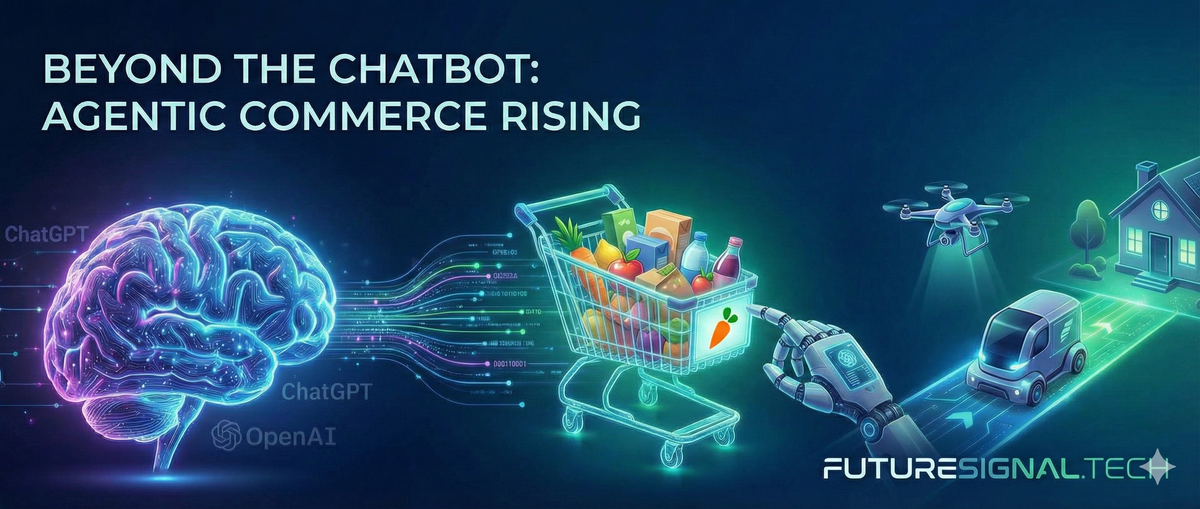
The integration of Instacart into ChatGPT, launched on December 8, 2025, marks a pivotal moment in the evolution of artificial intelligence: the transition from generative models that synthesize information to agentic systems that execute economic transactions. Built on the open-source Agentic Commerce Protocol (ACP), this partnership addresses the "last mile" problem of conversational AI—converting intent into physical fulfillment. This analysis examines the dual-layer architecture enabling this shift, the reduction of cognitive load in consumer workflows, and the profound economic implications of disintermediating traditional search-based commerce.
Introduction: From Generative to Executive AI
For the past three years, the dominant narrative in artificial intelligence has been "generative"—the ability of Large Language Models (LLMs) to create text, code, and images. However, as 2025 draws to a close, a new paradigm has emerged. The passive chatbot, capable of conversation but incapable of action, is being superseded by the "AI Agent"—a system designed not just to recommend solutions, but to execute them.
The December 8 integration of Instacart’s fulfillment network into OpenAI’s ChatGPT is the first mass-market deployment of this capability. By enabling 700 million weekly active users to transition from meal planning to doorstep delivery without leaving the dialogue interface, OpenAI and Instacart have effectively operationalized "Agentic Commerce."
This development is not merely a user interface optimization; it is a fundamental restructuring of the digital economy. It suggests a future where the primary interface for commerce is not a catalog or a search engine, but a conversation.
Technical Architecture: The Challenge of Deterministic Fulfillment
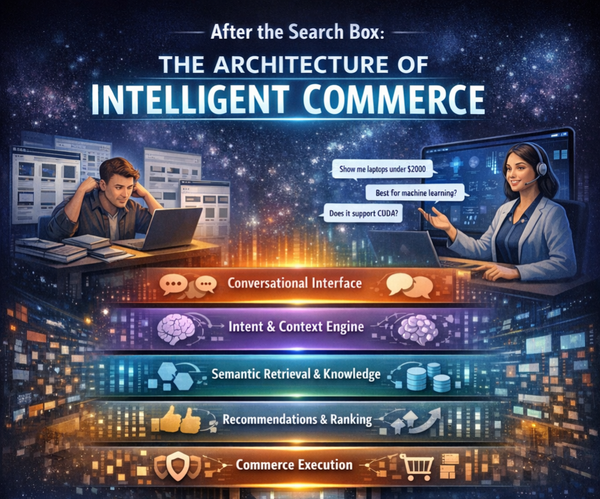
Connecting a probabilistic engine (an LLM) to a deterministic system (grocery inventory) presents a significant engineering challenge. The ChatGPT-Instacart integration solves this through a "Dual-Layer" architecture that bifurcates the cognitive load from the logistical execution.
1. The Semantic Layer (Intent Resolution)
At the frontend, OpenAI’s frontier models handle the messy reality of human intent. When a user requests a "dinner plan for a vegan athlete," the model must perform complex semantic parsing: disambiguating "protein-rich" from vague descriptors, accounting for implied dietary restrictions, and translating abstract culinary concepts into concrete lists of goods.
2. The Fulfillment Layer (Inventory Synchronization)
The backend relies on Instacart’s real-time inventory graph, which covers over 100,000 stores across 1,800 retail banners. The critical innovation here is the API’s ability to handle "inventory volatility." Unlike digital goods, grocery stock fluctuates by the minute. The system utilizes the Agentic Commerce Protocol (ACP)—an open standard co-developed by OpenAI and Stripe—to perform real-time "availability handshakes." This ensures that when the AI suggests an ingredient, it is physically purchasable at a local store, reducing the "hallucination rate" of the transaction to near zero.
User Experience: The Collapse of the Funnel
Traditional e-commerce relies on a multi-stage "funnel": Search $\rightarrow$ Browse $\rightarrow$ Compare $\rightarrow$ Cart $\rightarrow$ Checkout. This process is friction-heavy and cognitively expensive.
The agentic model collapses this funnel into a single, continuous loop. Consider the "Thanksgiving Scenario":
- Traditional Workflow: A user finds a recipe on a blog, opens a grocery app, manually searches for 15 ingredients, toggles back and forth to check quantities, and finally pays.
- Agentic Workflow: The user prompts, "I need to host Thanksgiving for 12 people. Three are gluten-free, and one hates cilantro. Plan the menu and fill my cart."
In the latter, the AI acts as a high-level logic layer. It parses the constraints (12 people, gluten-free, no cilantro), selects appropriate recipes, maps them to local SKUs (substituting standard soy sauce for Tamari, for instance), and presents a finalized cart for review. The cognitive load shifts from the human user to the digital agent.
Strategic Context: The Battle for the Interface
The appointment of Fidji Simo, formerly of Instacart, as OpenAI’s CEO of Applications in May 2025 was a harbinger of this strategy. OpenAI is systematically moving to capture the "intent layer" of the internet.
By integrating high-frequency, low-latency transactions like grocery shopping, OpenAI is attempting to preempt Google’s traditional dominance in search. If a user can buy dinner directly through a chatbot, the value of a Google Search query—and the advertising revenue attached to it—diminishes.
This is supported by a burgeoning ecosystem surrounding the ACP. With major players like Salesforce, PayPal, and Checkout.com adopting the protocol, the industry is signaling a move away from proprietary "walled gardens" toward an interoperable standard for AI-driven commerce.
Ethical & Economic Implications: The Principal-Agent Problem
As we delegate purchasing authority to algorithms, we encounter a digital version of the "Principal-Agent Problem." If an AI agent selects a brand of pasta for the user, whose interests is it serving?
- The Principal (User): Wants the best price and quality.
- The Agent (AI Platform): May be incentivized to prefer partners who pay higher commissions or affiliate fees.
While OpenAI asserts that product results are organic and unsponsored, the opacity of closed-source models (proprietary LLMs) makes external verification difficult. As "Digital Gatekeepers" shift from search engines (which rank links) to AI agents (which select products), the potential for commercial bias becomes a critical regulatory question.
Furthermore, this technology risks deepening the digital divide. The prerequisite stack for agentic commerce—high-speed internet, digital literacy, and credit access—remains out of reach for many. As efficiency gains accrue to the digitally native, the "time tax" on lower-income households (who must still shop manually) may relatively increase.
Conclusion: The "Web of Agents"
The launch of Instacart on ChatGPT is an early instantiation of the "Web of Agents." We are moving away from a web of static pages designed for human eyes, toward a web of dynamic APIs designed for algorithmic interaction.
For the consumer, the promise is liberation from the drudgery of logistics. For the market, it is a creative destruction of the advertising-based business models that have defined the last two decades of the internet. The question is no longer if AI will reshape commerce, but who will control the agents that negotiate our economic reality.
🛠️ Technical Deep Dive: Inside the Agentic Commerce Protocol (ACP)
While standard APIs rely on rigid, pre-defined inputs (e.g., GET /product/12345), the Agentic Commerce Protocol (ACP) is designed to handle the ambiguity of natural language. It functions as a translation layer between the probabilistic world of LLMs and the deterministic world of inventory databases.
Here is the architectural flow for a user request: "I need ingredients for a spicy gluten-free pasta for four people."
Phase 1: Intent Extraction & Schema Mapping
The LLM (ChatGPT) first converts the user's vague conversational intent into a structured JSON-like payload defined by the ACP schema. It infers quantities based on the "four people" constraint.
Mock Payload (The "Query"):
JSON
{
  "transaction_id": "req_8x99s7",
  "context": {
    "dietary_flags": ["gluten_free"],
    "serving_count": 4
  },
  "items": [
    {
      "semantic_target": "pasta",
      "attributes": ["spicy", "penne", "fusilli"],
      "strictness": "flexible"
    },
    {
      "semantic_target": "sauce",
      "attributes": ["arrabbiata", "spicy_marinara"],
      "quantity_min": "24oz"
    }
  ]
}
Phase 2: The Inventory Handshake (Real-Time Resolution)
This payload is broadcast to the fulfillment partner (Instacart). Unlike a static database query, the ACP allows for "Fuzzy Inventory Matching."
- The Challenge: The specific "spicy gluten-free penne" might be out of stock at the nearest Safeway.
- The Agentic Solve: The protocol returns a
resolution_object. If the exact match fails, it uses thestrictness: flexibleflag to identify the nearest vector neighbor in the product database (e.g., "Gluten-Free Spicy Rotini") without breaking the transaction flow.
Phase 3: The "Human-in-the-Loop" Confirmation
The resolved cart is returned to the chat interface. Crucially, the ACP dictates that this state is "Provisional." The user sees:
"I found 'Banza Chickpea Rotini' and 'Rao's Arrabbiata Sauce'. Total: $14.50. Shall I proceed?"
Phase 4: Secure Tokenization (The "Blind" Payment)
Upon user confirmation ("Yes, buy it"), the transaction executes via Stripe's embedded rails.
- Security Architecture: The LLM never accesses the user's raw PAN (Primary Account Number).
- Token Exchange: OpenAI passes a
payment_intent_tokento Stripe. Stripe matches this with the user's stored vaulted credentials and returns asuccess_signalto Instacart to release the order. This separation of concerns (Church-Turing separation) prevents the AI model from becoming a vector for financial data leakage.